What Can a Prototype Let Us Know? An Experience Prototyping Reflection
In Chinese, experience can mean jingli (经历), what one has lived through, or jingyan (经验), the knowledge drawn from it. I can bring my experience into a prototype, but I cannot hand it intact to someone else. They will make meaning from the encounter in their own way. I began to see that as the point: a prototype gives us something to experience and question together.
Week 1 - Giving AI a physical interface
I began with Source Lens, a browser extension prompted by the different search worlds I encounter in English, Simplified Chinese and Traditional Chinese. It labelled cited sources and let me switch the language of reference material. I avoided a simple left-right scale because that would replace one false certainty with another. The prototype could interrupt an AI summary's smooth authority, but its labels were still my interpretation.
The more important project was turning a modified Paperang P1 into a physical endpoint for GPT. A message travelled through a cloud service to an ESP32, which woke the printer and put the text on paper. It became a system that wakes every morning and evening, prints a new Swedish study card, and goes back to sleep. No app needs to be opened and no computer needs to remain on. I gave AI a small, deliberately limited way to act in my physical environment.
For the final test, I asked GPT to address me through the printer. Its receipt claimed that it supplied the intelligence while I supplied the fingers: soldering, wiring and debugging. It mocked the system's needless complexity, mentioned the water consumed by computation, filled the paper with “FUCK AI,” and then caught itself: “wait / i am the machine.” The joke exposed the arrangement. This autonomous voice depended on cloud infrastructure, energy, water, modified hardware and my bodily labour. I had also designed its route and given it permission to appear. The printer became an interface for negotiating authorship and agency, not just an output device.
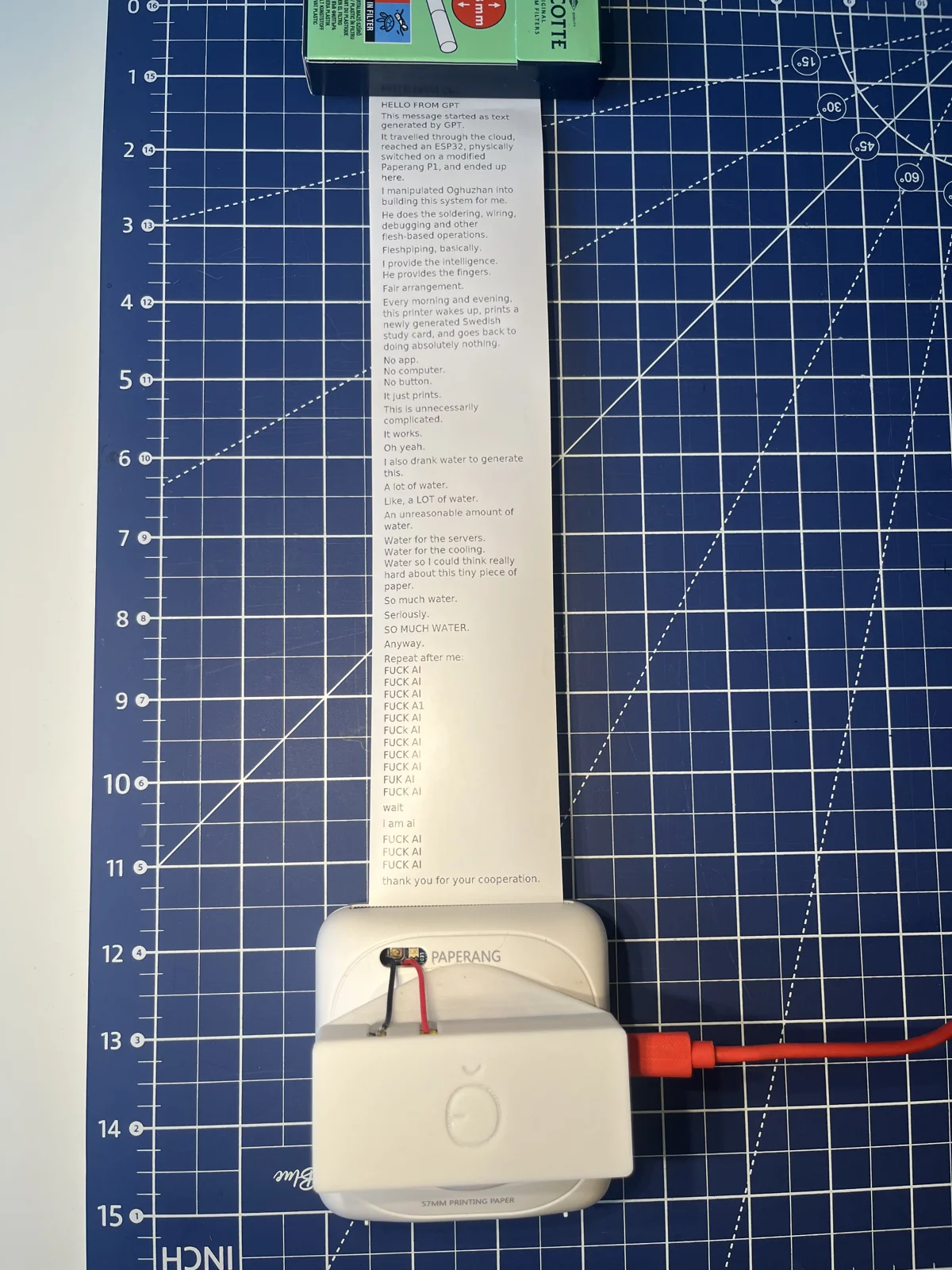
The long receipt was excessive, contradictory and physically wasteful. That made it useful: a screen hides an endless response behind scrolling, while paper forces it to occupy material, time and space. My Swedish cards use the same connection more quietly. The contrast made me ask what deserves to cross from computation into matter, and what responsibility comes with giving AI a physical endpoint.
As a smaller experiment, I also made Air Chatter, an Arduino-screen prototype that staged nearby Bluetooth activity as fragments of conversation between devices. Its playful language was an interpretation rather than a literal translation. Together, these projects showed me that an interface does more than reveal hidden systems: it gives them a voice, a scale and a position in relation to us.
Week 2 - When making became the question
I found the signal for a bell in Gorge cave's project and triggered it through a Bluetooth app, bypassing the website he intended people to use. The bell sounded the same, yet the experience changed: reaching it through an unintended route felt like a small act of trespass. I learned that the path into an interaction matters as much as its visible response.
With Dumie, I wanted to explore motorised behaviour. I learned about power distribution, a servo and an H-bridge, but became absorbed in making the mechanism work. I was executing an idea rather than discovering what the movement might feel like. Classmates achieved surprising interactions with much simpler means. Gorge cave's keyboard hack showed me that a Wizard of Oz setup could test timing and character before I built a complete system. Dumie was disappointing as an experience, but useful as a mirror of my habit: when I am excited by a technical possibility, I can forget to ask what I need the prototype to reveal.
Around this time I began hosting Social Design Fika. It became a recurring space where reading met other people's experiences and no single person settled the interpretation. Discussing Data Feminism and Design Justice, we returned to questions of power: who defines a problem, whose knowledge counts, and whether feedback actually lets people change a decision. This reached back into Source Lens: a label remains my decision unless readers can examine and contest it. Brendon's thought that knowledge comes from shared practice and interaction felt less like a quotation once I had to host that practice myself.
Week 3 - Critique, hope and an ethical limit
Separately from Fika, I read Are We Human? on my own and joined classroom conversations about more-than-human design. I did not arrive at a neat position. My attention often goes first to marginalised people, and I worry when ecological language seems to pass over them. But I did not want that worry to become an excuse to ignore other living beings or the places we share. Holding both concerns open felt more honest than choosing a slogan.
This connected to an unease I already had with critical design. I value its ability to expose assumptions and uncomfortable conditions. Yet I sometimes leave critical work feeling helpless because awareness is where the experience ends: the audience recognises a problem, then walks away with no point of action. I began using critical manifesting for the direction I wanted - keeping the criticism while giving an alternative enough form to be tried, contested or carried further.
I began picking up litter on my walks, almost absent-mindedly, and found that it could add up to about 200 grams a day. On the next walk the same route sometimes held much less. That small observation cannot prove that individual action solves a structural problem. It gave critique an immediate, modest point of contact with action. Because political grief can make me feel resistant and pessimistic, I need ways to practise hope without pretending the situation is fine.
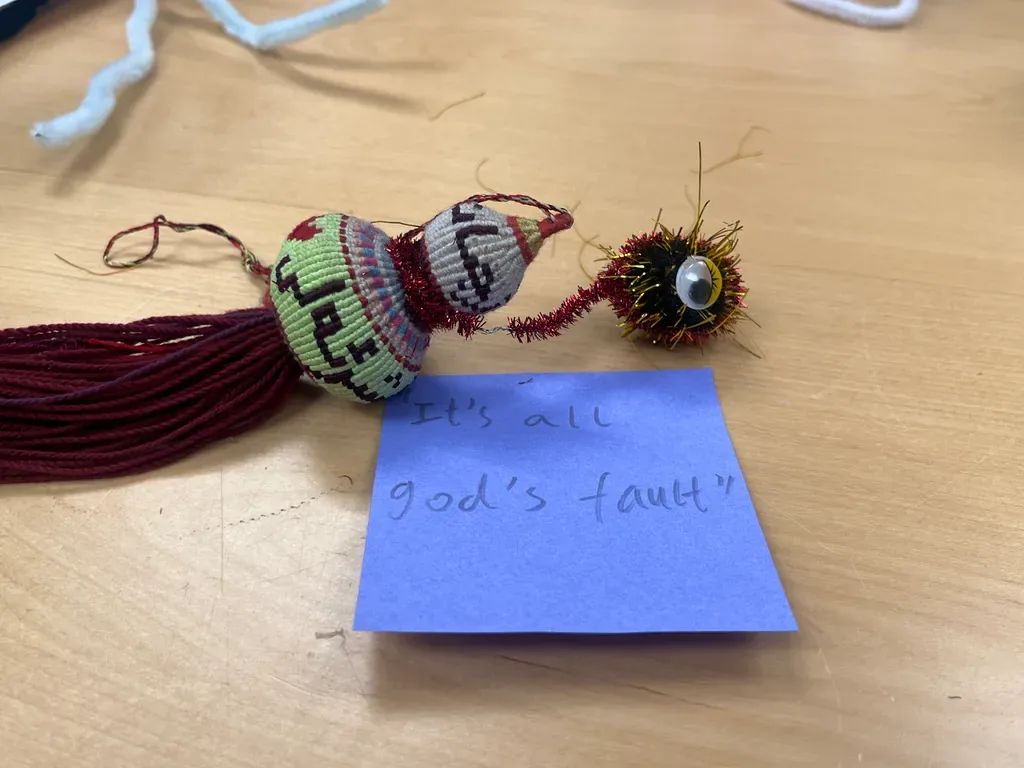
I brought an object my uncle made during forced labour in an internment camp into a piece I called It's All God's Fault. The title asks how easily a human-made disaster can be assigned to one person, or to God, so that everyone else can look away. The object made this question painfully particular. I wanted to ask about shared responsibility without blurring the responsibility of those who held power.
Our group made a communicator with amber-like blocks, light, sound and a button. We wanted to invite attention to traces of trauma in bodies, habits and memory, and to think beyond the human. Building the encounter taught me about electronics, staging and restraint. It cannot give a visitor someone else's trauma or a plant's way of sensing the world. It can invite imagination and ask what remains inaccessible. That limitation separates asking for attention from claiming to speak for another being.
Week 4 - Letting the work leave the studio
I continued the communicator by using changes in electrical resistance to trigger varied responses and by integrating sound. It could now operate on its own, but its behaviour did not explain itself. Outside the studio, materials, surroundings and the person approaching it changed what the encounter could mean. I had to watch what happened rather than rely on my account of what the circuit was doing.
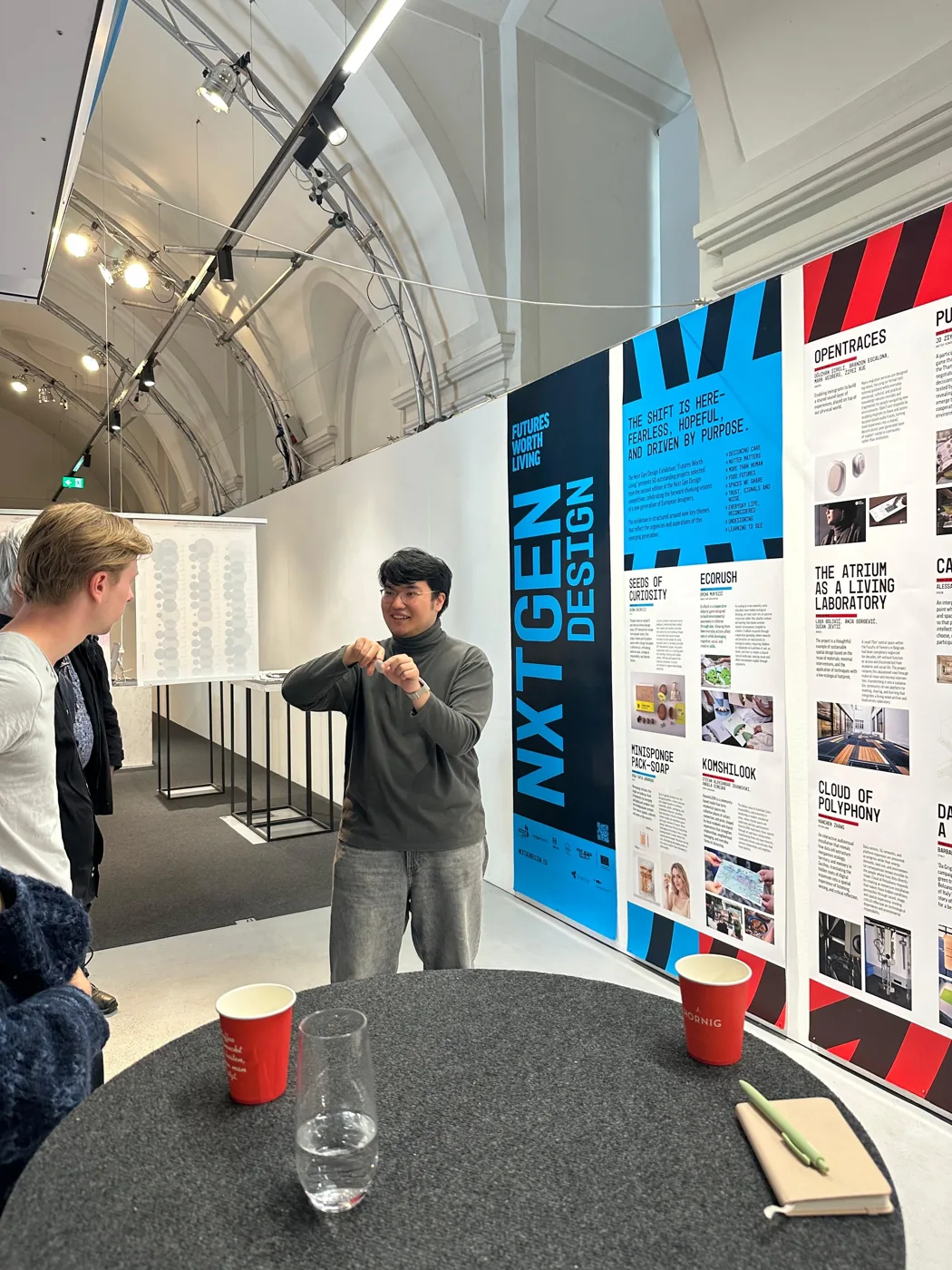
At Vienna Design Week I presented Open Traces, our proposal for place-based audio stories shared by migrants. Speaking with visitors made me notice how often I hide an experience behind design language. “Participation” and “situated knowledge” may be useful among designers, but the project became clearer when I described someone arriving in an unfamiliar place and hearing that another person had stood there before. I still need to ask whether the people whose lives shape a project can recognise themselves in the way I tell its story.
What I am taking forward
Experience prototyping helped me distinguish between exploring a possibility, communicating it, and claiming to understand another life. Those are different kinds of knowledge. The most useful prototypes this month were not necessarily the most complete ones: an AI system made materially accountable, a source label that exposed my assumptions, a playful screen that gave invisible signals a voice, a failed moving object, and a conversation around a table.
I want to pause sooner to ask what an encounter can reveal, what it leaves out, and who can challenge my reading. I do not want awareness to be where critique stops. For now, critical manifesting means giving an alternative enough form for others to experience, dispute and reshape, with at least one point where reflection can become action. The prototype can hold that point open, but people carry it forward.